
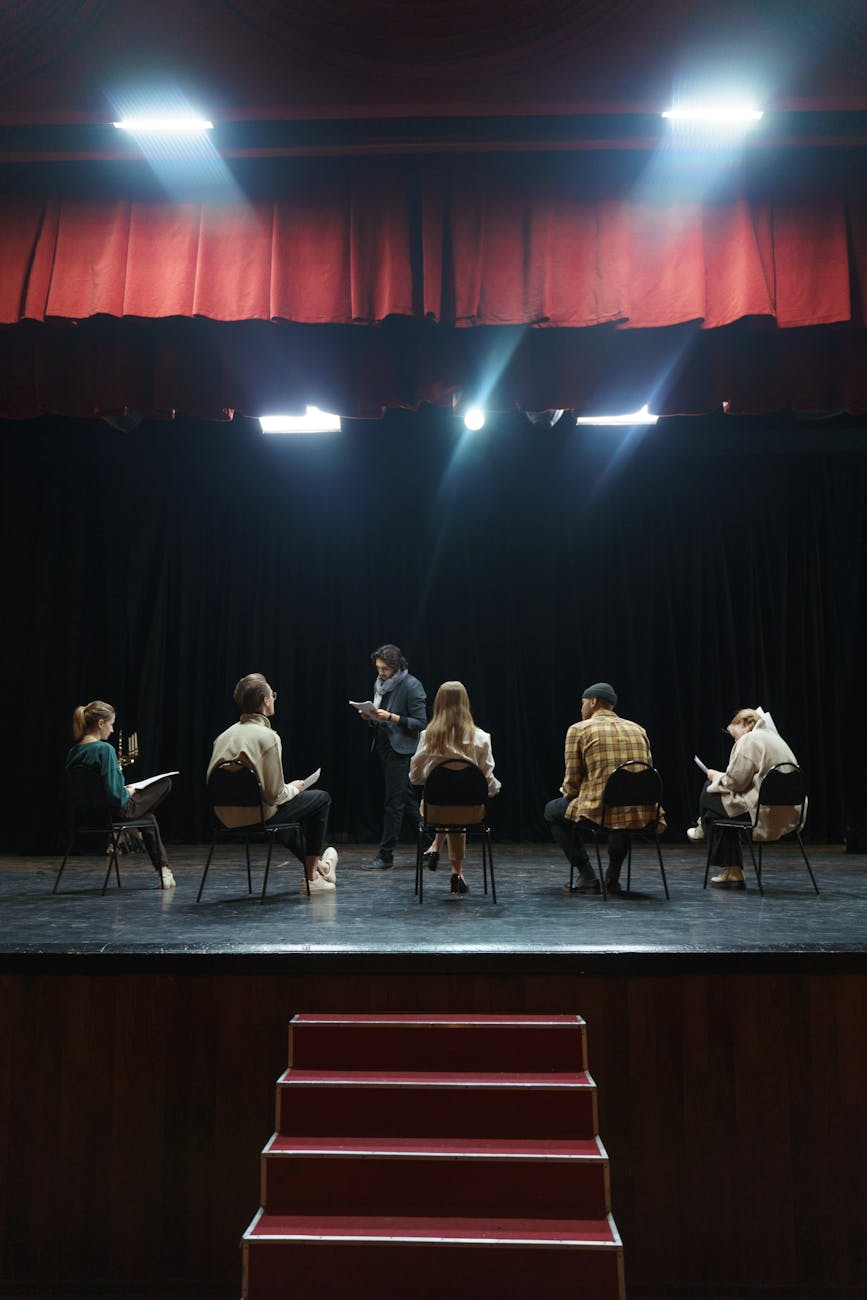
My husband recently recruited me to join him on stage for a community theater production of the musical, You’re a Good Man, Charlie Brown.
A few weeks into rehearsals, he came home with an offer: the director wanted to know if I’d be interested in playing the role of the Red-headed Girl, Charlie Brown’s unrequited love interest.
I am not an actor.
But, because it wasn’t a speaking or singing part, and because I know that socializing with human beings will help me acclimate to our new German address, I said, “Why not?”
So, I started attending rehearsals and mostly watched from the sidelines as the whole thing came together.
Last week was opening weekend, and, while we still have another weekend of shows to go, I’ve realized I’ve learned a lot from this experience, all of which can be easily translated to the office. Here are my top five takeaways:
- Trust. Even if you memorize your own lines and hit your mark on stage, you are reliant on your fellow cast members. It’s like a trust fall. Everyone has a particular role to play – just like in business and work – and we rely on each of them to play that part. There’s collaboration, but everyone is also clear on their swim lanes. Lucy wasn’t stepping on Sally’s toes; Linus didn’t try to upstage Charlie Brown. There’s a spirit of cooperation that should be more evident in the office, but, sadly, could probably use some improvement in many corporate settings.
- Passion, energy, fun. Every rehearsal, the cast members brought each of these values and characteristics to the stage. Even on the hard days when it felt like nothing was coming together, they kept at it. While individuals may have been hard on themselves, there was an overwhelming spirit of cooperation. In business, we talk about psychological safety. Mostly on the sidelines of You’re a Good Man, I got to see that psychological safety in action. Support to experiment, to fail, to forget lines, to ask to rerun something that fell apart mid-song or dialogue. All without finger-pointing or frustration.
- Communication. Of course, a production isn’t just the cast. There’s an entire team that makes the magic happen. From the stage managers to the tech team and the production team, it takes a village to pull off even a community theater show. And it takes a village that knows what the other is doing to react or engage in the most appropriate way. For example, the director had to communicate to the stage managers when certain props had to be placed on stage; the lighting crew needed to understand where and when spotlights or other lighting cues were taking place; and the sound team had to listen to the actors’ singing to ensure the music played was timed appropriately. When everyone was clear on the intention for each scene, they were able to bring their A game – and put together a seamless experience for the audience.
- Getting out of your comfort zone. This one was especially personal for me. I’d done a single improv class in New York City; acted in exactly one one-act play for a college friend who had to write and direct it for her senior project, and took one beginner acting course as a general education requirement. Getting on stage and being looked at by dozens of people isn’t really something I love the idea of doing. But I’m glad I did it – and I didn’t die. I didn’t get nauseous. I didn’t turn bright red. I survived. And I kind of liked it. Growth is good, so pushing yourself to get outside of your comfort zone is necessary.
- Vision. The director sets the vision for the production, but the cast is encouraged to make their characters their own (to a certain degree). Providing guidance and inspiration on how a character might be feeling and reinforcing the bigger picture of the story is the director’s primary role. She didn’t micromanage the cast; she let them play, be creative and put their own finesse on their roles. Just like any good director (or manager).
All in all, I’m glad the hubby took the leap to participate – and that he dragged me along with him. It’s interesting to see how similar the requirements are for high-performing teams across industries – and to recognize areas for improvement.
As for my future in the performing arts? We’ll see. But for now? It’s a wrap.
Be good. Do good. ✌
Leave a Reply